Here are some other knives. I think they are well suited to reenactors, history fans, or others interested in traditional and functional knives.
Index
** As you will notice, There is no longer pricing for these on this website, Information only, Please visit https://ragweedforgestore.com/collections/river-traders For Purchases and New models**
https://ragweedforgestore.com/collections/condor https://ragweedforgestore.com/collections/old-hickory
CONDOR TOOL & KNIFE traces its history back to 1787, the year GERB WEYESBERG COMPANY was founded in Solingen, Germany. In 1964, the company formed IMACASA with a new plant in Santa Ana, El Salvador, and filled it with state of the art German equipment and expertise. If you are interested you can read more of the history here.
The knives are stout working patterns with little or no polish. They come with full tang blades of German 1075 carbon steel, hardened and tempered to a hardness of 56-58 on the Rockwell Scale.. The handle scales are hardwood, and are rounded and beveled for all-day working comfort.
The Condor 4" Basic Bushcraft is a stout bushcraft tool. .The sharpened part of the blade is about 3 1/2" long, and the bade is about .119" thick. The blade is 1075 carbon steel, hardened to 56 - 58 on the Rockwell scale. The point has a good bit if belly for skinning chores. Except for the bevel it's coated in black powder epoxy to help prevent rust. The handle is about 4 1/2" long, and feels good in my small to average sized hand. The knife weighs about 5 1/2 ounces and feels solid. Weight with the sheath is about 9 ounces. While not flashy, it's a nice piece of kit for
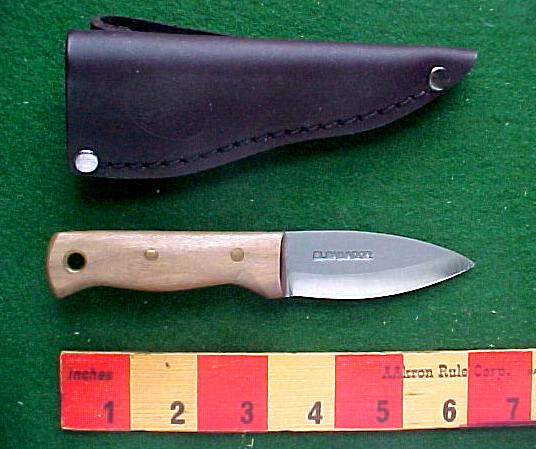
The Condor Mini Bushlore has a blade only 2 3/4" long, 1" wide and .112" thick. Tha handle is about 3 1/2" long. I can just get all four fingers on the handle, but for those with large hands it's going to be a three fingered grip. Despite the small size, it has the full tang construction of it's bigger brother. It's very stout. The knife and sheath weigh about 4 3/4 ounces.
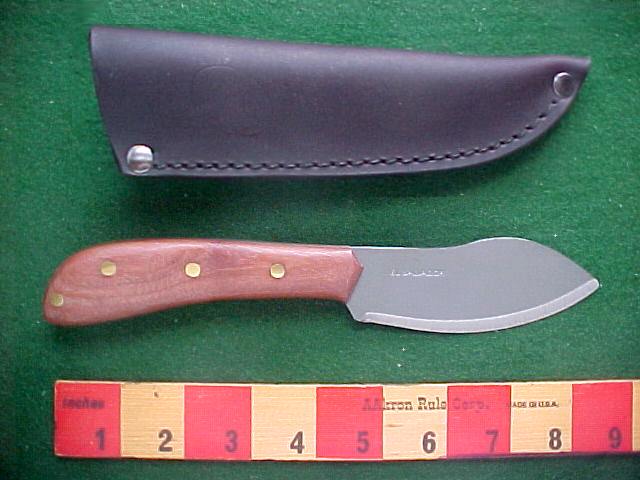
The Condor Nessmuk is patterned after the knife designed by the well known outdoorsman George Washington Sears in the late 1800's. His book "Woodcraft and Camping" is excellent. You can download a free copy from Project Gutenberg.
The knife itself has a blade about 3 3/4" long, 1 1/2" wide, and .113" thick. The distinctive hump facilitates opening big game without puncturing the internal organs. Again the handle is about 4 1/2" long, and is sized for average hands. The leather sheath is well made, and holds the knife securely.
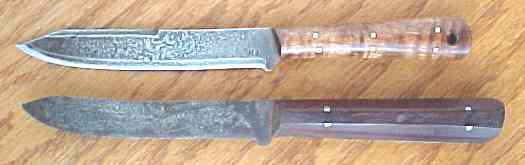
During the Colonial Period, knife blades were often traded rather than finished knives. This saved space in shipping, and customers were often unwilling to pay for something they could make themselves (the handle portion). These are hand-made replicas of the finished knives. They are made of properly tempered 1095 spring steel and take a good edge. Like the originals, they are quite thin (about .062" or just under 1/16") so they are light to carry and make good slicers. The sides are lightly polished after heat treat and the residual scale resembles damascus. The knives are hand crafted here in the U.S. by Dean Oliver so each one is a bit different. They come with nicely figured Maple handles and brass pins. No sheath is supplied, but it's not that hard to make your own. If you prefer, I now have some quality sheaths made by Dean's wife Midge, shown below.
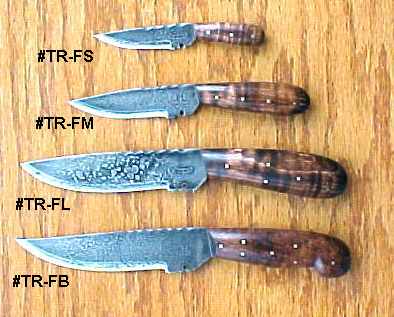
French drop point trade knives are a done in a classic all-purpose pattern. They come in several sizes.
#TR-FS; the small drop point is just right for a neck knife or patch cutter. The blade is about 2 3/4", and the length is about 4 3/4".
#TR-FM; the medium drop point is a more generally useful size, with a blade length of about 3 1/2", and a length overall of about 6 1/2".
#TR-FL; the large drop point has about 5" of blade and is about 9" overall.
#TR-FB; this one has the very early ball end on the handle. Besides being very authentic, I think it improves control.
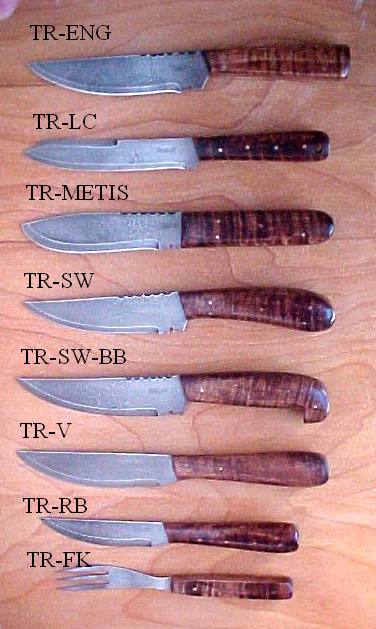
#TR-ENG: the English trade knife is modeled after the straight-forward English trade goods of the period. The handle is of hexagon form rather then the rounded form of the French drop points. The 5 1/4" blade is straight backed, and the knife is about 9 1/4" overall.
#TR-LC; the Lewis & Clark is modeled after an example associated with the famous expedition. Interestingly, it is very similar to a very early "I Wilson" knife in my collection. The blade is fairly narrow and straight, with a clip to form a acute point. It's about about 5" long. .
#TR-M; the Metis pattern reminds me of a Green River Dadley style. It would make a good all around utility and butcher knife. The blade is just over 5", and the knife is about 9" overall.
#TR-SW: The Southwestern has a strongly curved upswept blade for skinning.
#TR-SW-BB; The Southwestern bird-beak style is a also a trailing point skinning knife. The handle has a pronounced bird beak at the pommel to lock your hand in place, even when it is wet or slippery. The blade length is just over 5".
#TR-V; the Voyager is a very traditional blade pattern that goes back to medieval times, and earlier. The blade has a bit of a curve to work against a block or for occasional skinning. The blade is about 4 3/4" long, and the knife is about 8 1/2" overall.
#TR-RB; the Roach Belly is the smaller version of this classic early shape. It has a rounded handle that really feels good in my small to average sized hand. The blade is a bit under 4", as is the handle. I think this is my favorite of the lot.
#TR-FK: the Trade Fork is an eating fork made in the same style as the others. In Newman's "Collector's Illustrated Encyclopedia of the American Revolution" (p. 109) stick tang eating forks are shown as two tined, full tang forks like the Trade Forks are three tined. These are nicely done with hexagonal handles and could be matched with several of the knifes above. (It was common for the knife and fork to be similar in style, but not the spoon.)
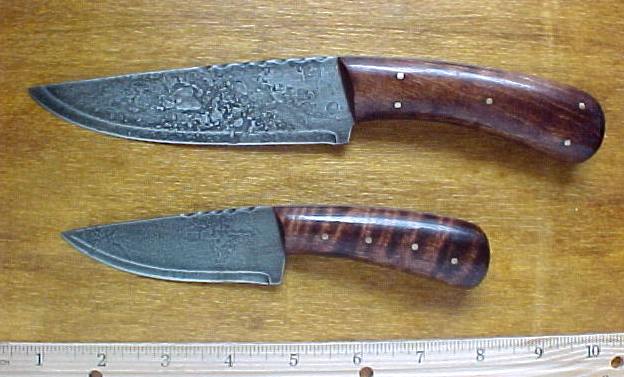
Courer de Bois is French for "woods runner". The term refers to the independent French traders and explorers who ran the North American wilderness in the days of New France. They were known for “adopting the ways of the country” and their close relationships with the native Americans. This is the type of knife they would have appreciated. It’s similar to the French Trade knife shown above, but lacks the decorative notches at the base of the blade. This gives you more useful edge. It’s particularly helpful in working with wood, because you can use the edge at the base of the handle where leverage is greatest. In two sizes:
#TR-CDB-LG; Large, with a blade just over 5" long, 1 3/8" wide at the base, and .063" thick;
#TR-CDB-MED; Medium, with a blade about 3 1/2" long, 1 1/4" wide at the base, and .063" thick.
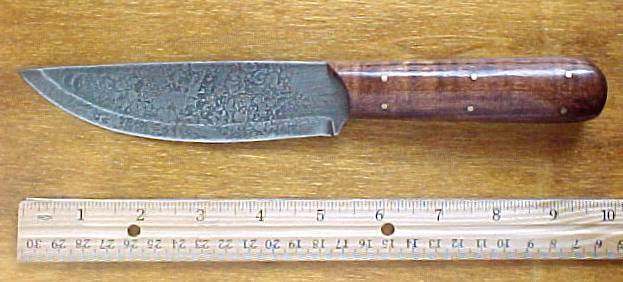
#TR-HBR; For those who prefer a slightly thicker blade I've added the Hudson's Bay Roach. The blade is about 5 1/2" long, 1 1/4" wide, and .093" (about 3/32") thick. As the name implies, it has a bit of belly for skinning and butchering.
TR-HBRS: The matching sheath is
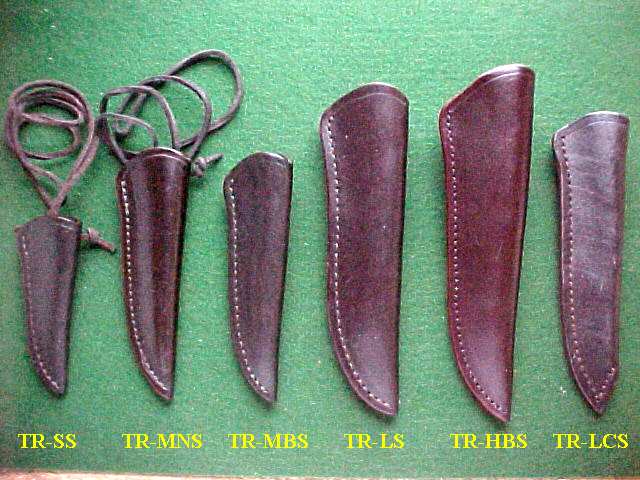
I've finally found some good sheaths for the trade knives. The ones I carried in the past were made of leather that was too thin, and too soft. These are stout, stiff, and sewn with a welt. They are made by Dean's wife, Midge. The belt sheaths have a loop riveted to the back that will easily take a 3" belt. They do not have a liner, so you want to be careful to avoid forcing the knife too deeply into the sheath as it stretches from use. It shouldn't be a problem unless you routinely hammer the knife into the sheath. It's simple enough for you to add a liner, but it will vary a bit depending on which knife you are using . There are several sizes.
Small; #TR-SS, fits the Small French and comes with a neck thong.
Medium Neck; #TR-MNS, fits the Medium French, and Roach. It also hangs from a neck thong.
Medium Belt; #TR-MBS, Similar to the Medium Neck, but comes with a belt loop that will take belts up to 2 1/2".
The Medium is also a fairly good fit for the Mora #2/0, as well as the #106..
Large; #TR-LS, fits the larger knives except the Hudson's Bay Roach. It has a belt loop.
Hudson's Bay Roach Sheath (a bit larger then the regular "large"); #TR-HBS,
Lewis and Clark Sheath; #TR-LCS, a long and narrow sheath for the Lewis & Clark trade knife or Boot knife, it also fits the Roach, taking most of the knife for a period-correct fit. #TR-LCS,
These are a good fit for the Mora Classic #1.
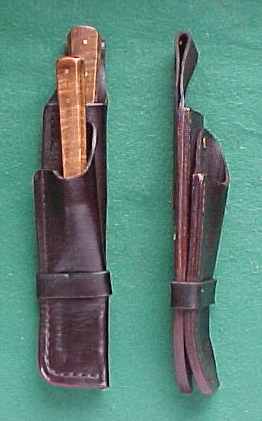
TR-KFS; is a sheath for the fork and a medium sized knife such as the Roach.. It's a convenient way to carry your eating utensils.
(The knife and fork are sold separately.)
**More options available and actual inventory at new website** www.ragweedforgestore.com
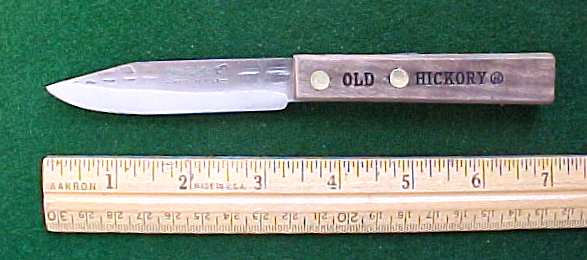
#OH-7533; The 3 1/4" Paring Knife is a basic paring or food prep knife. The blade is only .052" thick and 11/16" wide. The tang extends about half of the length of the handle.
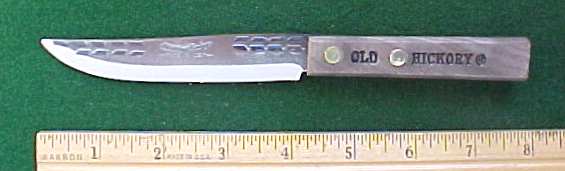
#OH-7504; The 4" Paring Knife is a just a bit longer. Again the blade is only .052" thick and 3/4" wide. The tang extends about the length of the handle. It would also do nicely as a patch knife. I think this one is shaped more nicely.
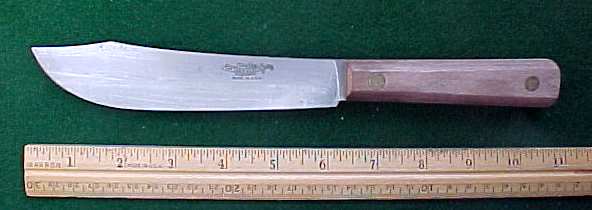
#OH-5075; The Cabbage Knife is really a scaled down butcher knife. The blade is just over 6" long, only .080" thick and flat ground from the spine of the blade. It would be an excellent slicer, and just the thing for butchering in the field. Even with the full tang, it weighs only 3 1/4 ounces, so it wouldn't be burdensome to carry along.

#OH-726; The Old Hickory Boning Knife also has a 6" blade, but it's stiff and narrow. The blade is .079" thick and saber ground for strength. It has a full tang, and would make a good general purpose knife for those who like 6" blades.
#OH-726x; I also have some factory seconds. I doubt you will be able to tell the difference after you have used them once or twice.
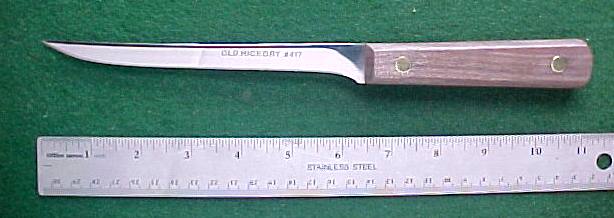
#OH-417; The Old Hickory Fillet Knife has a 6" blade, this time in stainless. The blade is .075" thick, polished to a mirror finish and has a full flat grind. Again, it comes with a Hickory handle and full tang construction for durability.

#OH-77; The Old Hickory 7" Butcher Knife would have been right at home in the sash of a colonial period Native American, or a Rocky Mountain fur trapper a hundred years later. The blades are about 7" long and only .081" thick. It's a serious slicer.
#OH77X; 7" Butcher Knife, Second Quality, I have some that are seconds. After you use them for a while I doubt you will be able to tell the difference.

#OH-758; The Old Hickory 8" Slicing Knife is lighter and quicker. The blade is about .055" thick. The thinner blade and long clip shape move the balance back toward the base of the blade, and keeps the weight under 4 ounces. This is a knife for all-day butchering with minimal fatigue.
#OH-758x; again, I have some "factory seconds"
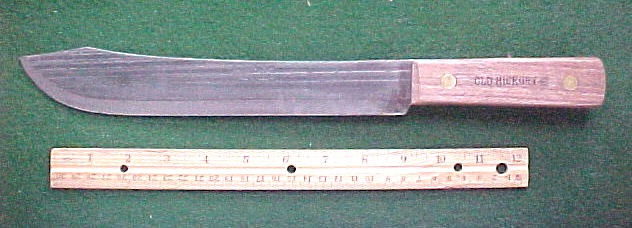
#OH-7111; The Old Hickory 10" Butcher Knife is a big knife with some weight to the blade. It would be suitable not only for butchering, but as a camp knife or even light machete. In other words, it fills the same role as the Scandinavian Leuku at a fraction of the cost. The blade is about 10" long, 1 1/4" wide at the base, and .098" thick. It has a full tang. The handle is about 4 3/4" long. The knife weighs about 9 ounces. There is no sheath.

#OH-7113; The Old Hickory 14" Butcher Knife is larger still. The blade is 14" long, 2" wide, and .115" thick. The full tang handle is about 5 1/2" long, and sized for average or larger hands. The knife weighs about 14 ounces with the balance point about 3 1/2" forward of the handle. There is no sheath.
Please Click on the Credit Card Symbol Below for the order form