Hello! Thanks for stopping in. Since I sell knives it seems I should sell the means to sharpen them.
Most of the knives I sell have the Scandinavian grind. The Scandinavian grind is a single wide, flat bevel that runs right to the edge. This results in an exceptionally keen edge that is easy to sharpen without jigs or other gadgets. The efficient functionality of things Scandinavian is evident.
This means you don't need a lot of equipment to keep your knife sharp. All you need is a flat abrasive surface. Some surfaces are more efficient, or handier, than others, so here are a few suggestions.
Diamond plates are the top of the line for easy maintenance of a good edge. Diamond plates are steel plates with abrasive diamond grit bonded to the surface. They cut quickly, but leave a relatively smooth surface. They can be used dry, or with water, rather than messy oil. Best of all they stay flat, and do not wear into the saddle shape typical of old sharpening stones. Since even industrial grade diamond is expensive, diamond plates cost more than most stones. They're worth it.
Large diamond plates have a lot more area than small ones. They cost a lot more. A large flat area is almost required for sharpening things like plane irons and other woodworking tools, but is not really necessary for knives. I own some large diamond plates, but seldom use them. I find the optimum size is about the size of a credit card, or just a bit longer. I carry one in my wallet, and I have it when I need it. I no longer worry about wearing it out. I've been using it for more than a decade and it hasn't slowed down much, although it's gotten smoother. It's always with me, so it sees a lot of use.
** As you will notice, There is no longer pricing for these on this website, Information only, Please visit https://ragweedforgestore.com/collections/sharpening For Purchases and New models**
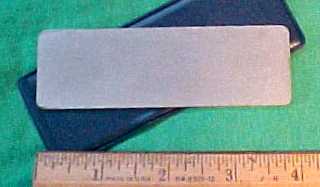
If I were starting over, and buying a single tool to sharpen my knives, this is what I would get. It has a medium (600) surface on one side and a fine (1800) surface on the other. It's 4" long, 1 1/4" wide, and less than 1/16" thick (.055"). The plate and it's plastic sleeve weigh about 1 1/4 ounces. Made in the USA.
If I were going to add anything, I'd get something for a super fine finish or strop. On single sided plates (see below) I often glue a strip of 9 micron polishing film to the back of the single sided plate. On the two-sided plate you could probably glue it to plastic sleave, or just keep it with the plate.
If you would like me to send a strip of film add $1. You do the gluing.
The single sided plates shown below are a close second, and actually fit a wallet better. They have the advantage of a blank surface you can use for the polishing film, which gives you the strop. If you keep your knives really sharp, and don't expect to need the medium surface, this may be the better option. However I personally prefer the slightly greater length of the Hewlett plates.
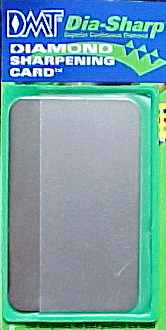
These are the size and shape of a credit card (3 1/4" by 2"). They come in several grades. I stock coarse (325 grit), fine (600 grit) and super fine (1200 grit). If you don't specify otherwise, I'll send a fine. With the plastic sleeve it weighs a bit under 1 1/2 ounces. It's not much thicker than a credit card (.069" in the sleeve), so it rides easily in your wallet. Made in the USA by DMT.
I like to glue a scrap of very fine (9 micron) aluminum oxide polishing film to the back of the plate for a final polish. If you you would like a piece to glue to the back of your plate, add $1. (You do the gluing.)
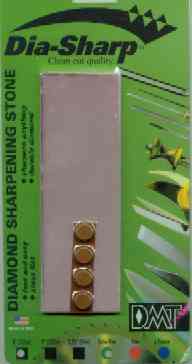
I've had some requests for larger diamond plates, so I've added these. I think they are overkill for most knives. But I have to admit that they are faster, especially when you are removing a lot of metal to establish an initial edge, or restore an abused knife. If you are going to sharpen chisels, plane blades, etc., they are almost a necessity. These are good ones, 6" long, 2" wide, and 1/4" thick to eliminate any chance of flex. There are several grits available, In the DMT brand I have Extra Fine (1200 mesh, 9 micron), Fine (600 mesh, 25 micron), Coarse (325 mesh, 45 micron). They come with rubber feet to help hold them still on the bench, but I have better luck with something more positive like a vise. At events I sometimes position one on the corner of my table with wood screws. If you are only going to get one, I think the fine grade is the most useful. If you are going to get one to go with a smaller plate, the coarse might be better. If you need to go to a bench plate you probably have some heavy duty stock removal in mind. Made in the USA. .

A while back I had an inquiry about sharpening kitchen knives. The credit card plates really won't do for these, especially the wider chief knives. At the time we decided on the large plates. I've found something better. These have the shape of a rounded triangle with a different grit on each side (Coarse (270), Medium (600), & Fine (1800)). The sharpening surface is about twelve inches long by 3/4" wide. This should be more than enough for the largest knives. You move from grit to grit with a turn of the wrist. The molded handle keeps your hand away from the sharp edges. I think these would be just the thing for either a professional or residential kitchen. Made in the US. But each stick gives you the same selection as all three of the large diamond plates, and in a better format for the purpose.
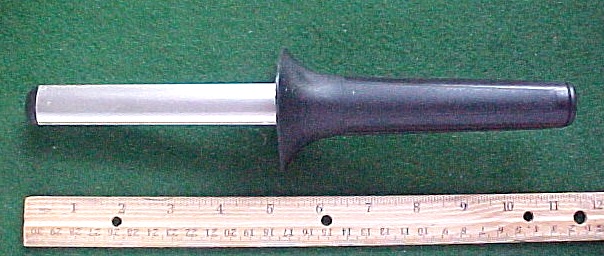
It's also available in a shorter version suitable for hunters, etc. The sharpening surface is just under 5" long.
Stones are the more traditional way to sharpen knives. There are many different kinds, but they can be roughly divided into Western and Japanese styles, both of which come in natural and artificial varieties.
Stones are much softer than diamonds, and wear away in use. The residue tends to clog the surface and interfere with the cutting action. Japanese stones avoid this by wearing away quickly, and exposing a new surface. They are used with a lot of water to flush away the residue, and require maintenance to keep the surface flat. Western stones wear more slowly, but still require liquid to flush the residue away. They also wear away to some extent, and require occasional flattening. The liquid used with Western stones can be either water or oil. Oil is recommended most often, but I prefer water. Oil makes a nasty mess, which gets on your hands, your work, and into your food if the knife is used for cooking. Water works nearly as well (I can't really tell the difference), it's cheaper, readily available, and the clean up is a lot easier. You can take a stone that has been used with water, dry it out, and switch to oil. But once you use oil on a stone, you are pretty much stuck with it.
Natural stones are more traditional, and often more attractive. Artificial stones are more consistent, and usually cheaper.
The Vikings selected their whetstones for beauty as well as function. They were sometimes selected for colorful contrasting bands, and sculpted into elaborate shapes. They apparently served ceremonial proposes as well, because some of the largest and most elaborate examples have been found in connection with royal burials, and in unused condition. In one of the Nordic legends a giant used a club-like whetstone as a weapon against Thor.
I'm often asked about the grit size of the various grades of Arkansas stones. Here's a link to the supplier's web site.
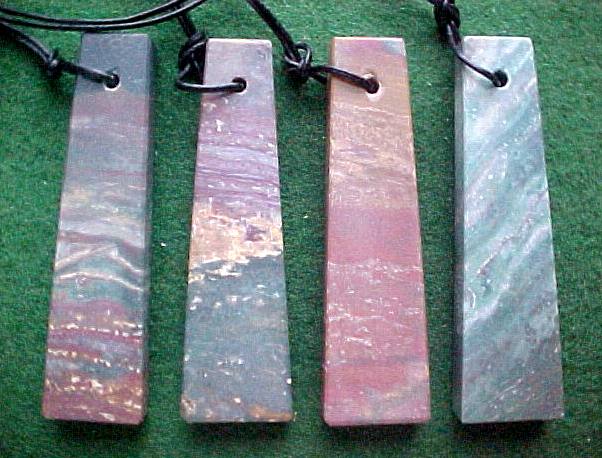
In Viking times small whetstones were often worn as pendants. These are reproductions of whetstone pendants found in Viking Age York. Similar pendants have been found in Kalåstad, Norway, Birka, and Gotland. They are cut from Jasper, and seem about midway between hard white and hard black Arkansas stones in action. That means they are very fine, and suitable for the honing a final edge rather than basic sharpening. They vary a little in size and shape, but most are about 3 1/4" long, just under an inch wide at the base, and 1/4" in thickness. Colors are mostly grays, browns and the occsaional green. If you have a preference let me know and I'll do my best. Each comes with a string and descriptive packaging. I use them dry, and clean off the clogging residue as often as necessary with water. Imported from Sweden, the price is
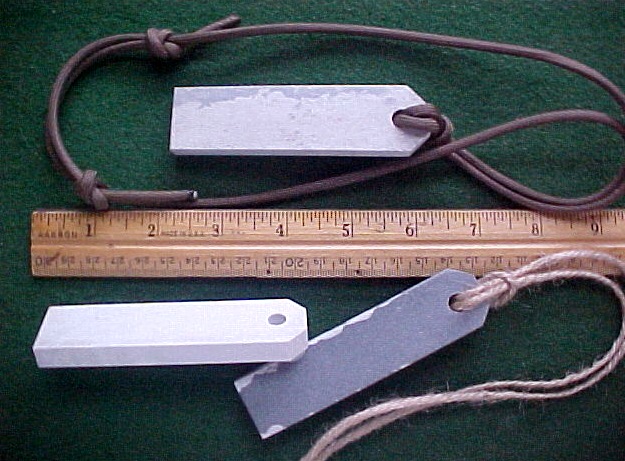
The Jasper Viking whetstones shown above will produce an almost frighteningly sharp edge. But they are too fine for basic sharpening. Here are some similar stones cut from soft Arkansas. This is the basic grade for general sharpening. It’s about 500 – 600 grit. You can follow up with the Jasper Viking stones for the finest of edges, but for general use these should be about right. They are mostly white or cream, but the color may vary through grays and molted patterns, to mostly black. The sharpening characteristics will be the same. The are about 4” long, 1” wide and 7/16” thick. I can string them on about four feet of either brown paracord, or a natural fiber cord. Four feet sounds like a lot, but with the adjustable knots shown it's about right. The cord can always be used for other purposes when out in the bush. Let know which you would prefer. If you don't specify, I'll send paracord.
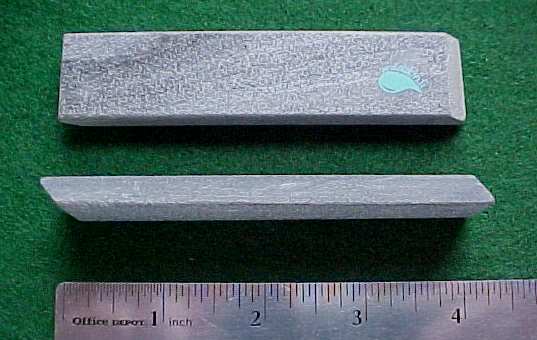
Whetstones have been quaried in Finland for centuries. These come from the village of Västilä, and are marketed by Wästikivi. You can visit the company webpage. The stones are used with water, and quickly form a slurry or paste that improves the performance. These are quite fine, and measure about 4" long, 15/16" wide and 5/16" thick. They are suitable for basic sharpening, and could be followed by the Viking stone above for polished shaving edge.
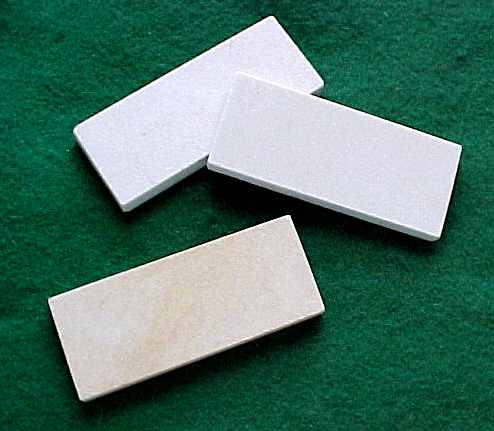
#AC-53; Soft Arkansas is usually graded as fine or medium fine. It's the grade most often used for general sharpening. These are about 2 7/8" long, 1 1/8" wide and 1/4" thick. As with all natural stones, there's some variation in color. Some have minor chips on the corners or edges, which will not affect the functioning.
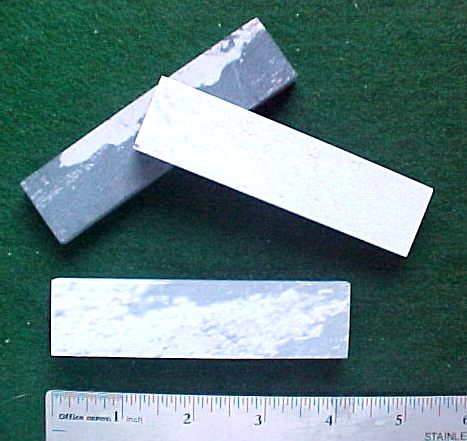
#AC-168; Larger soft Arkansas may be better for those who like a bit more length. They are about 4" long, 1" wide and a bit over 3/8" thick. As with all natural stones, there's some variation in color and size. While they are rated the same as the AC-53, they feel smoother to me. Perhaps they are just more highly finished
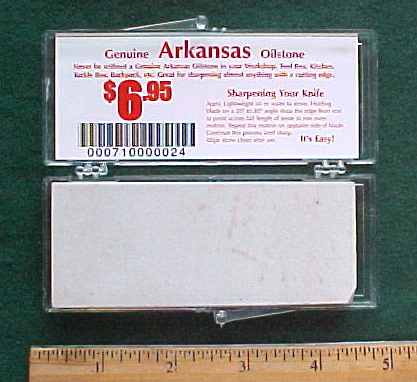
AC-2; These are larger still, and come in a plastic case. The stones are a little over 4" long, 1 1/2" wide and 1/2" thick. It's a bit large for the pocket and would be better carried in a pack or tackle box. The cutting is a bit rough and there are some with chipped corners. None of this affects the use of the stones. (The label in the case may vary.)
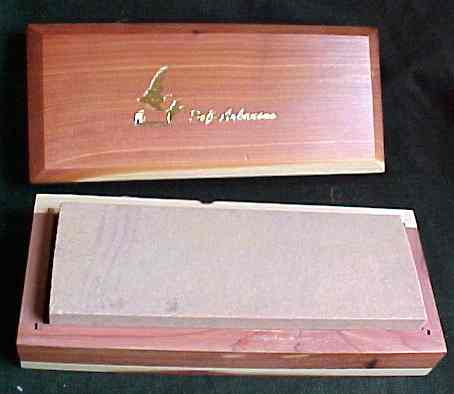
AC-12; Soft Arkansas stones are the grade usually used for general sharpening. The stones are supplied in a cedar box (nice smell!). They vary a bit, but are about 6" by 2" by 1".
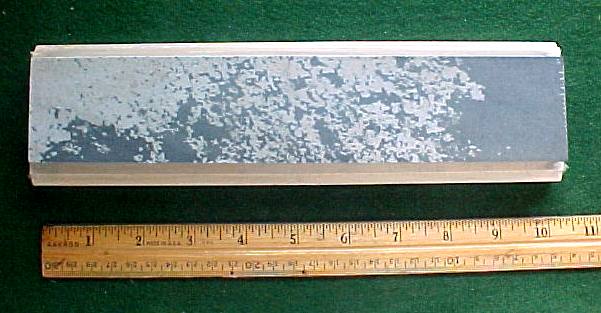
AC-11; As above, but about 10" long and mounted on a wooden base..

AC-13; Hard Arkansas stones are considerably finer than the soft grade, and are about as fine as most folks need before going to a strop. Again, the stones are supplied in a cedar box, and are about 6" by 2" by 1".
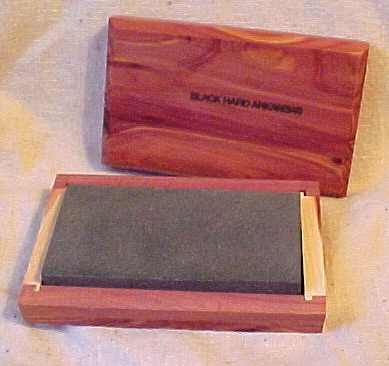
AC-15; Black Hard Arkansas stones are one of the world's best natural sharpening stones. The Black Arkansas is the finest grade ordinarily available. These are too fine for anything but the final edge on very sharp blades and tools. These are about 4"x2"x1/2", and come in a wood box.
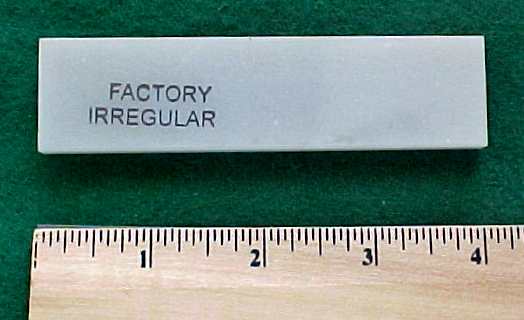
AC-88; Translucent stones are the finest, rarest, and usually the most expensive of the Arkensas stones. These are a handy pocket size; about 4" x1" x 1/2" and come in a leather pouch. They feel just a bit coarser than the jasper Viking Whetstones shown above. .
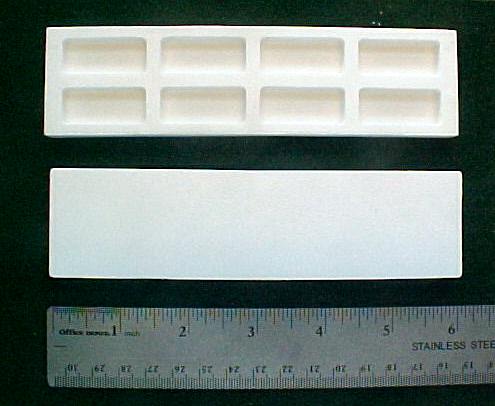
Ceramic plates are useful for maintaining a working edge. They are rated as 1000 grit, so you wouldn't want to use one to remove a nick, or for reprofiling. But they would be excellent to bring back an edge that has just started to lose it's bite. Ceramics are harder than other stones, so they tend to stay flat. You can them dry and clean off the residue as needed. They leave a surface that is satin polished, but rougher than the Viking Whetstones above. It's about as fine as you need to go for most purposes. The plates are about 6" long, 1 1/2" wide and 3/8" thick. The back has cavities to reduce mass, but they still weigh about 4 1/2 ounces each. They are for home use, not use on the trail. I got them on a close out, Out of Stock - Looking to find something similar to replace
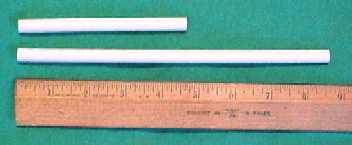
Ceramic sticks are useful for the final edge. They leave a surface that is almost polished. It is a bit coarser than the Viking whetstones shown above. I have two lengths, both about .368" (just under 3/8") in diameter; These would be easier to carry in the field than the plates. They are quite brittle, so some care is indicated.

AC-46; The ceramic stick in a hardwood handle is easier to work with, especially with larger kitchen knives. It's a bit under 12" overall, with about 6 3/4" of the ceramic stick exposed.
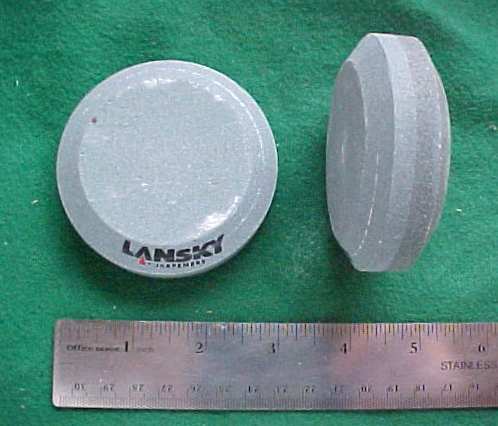
LSPK; The Lansky Puck is a two sided artificial stone for sharpening axes or other large tools. When sharpening large tools it's more convenient to move the stone on the tool. The stone is about 3" in diameter and 1" thick. The sides are beveled for a comfortable grip. One side is coarse (120 grit) for removing nicks, etc., and the other is a medium grit (280 grit). Made in the USA.
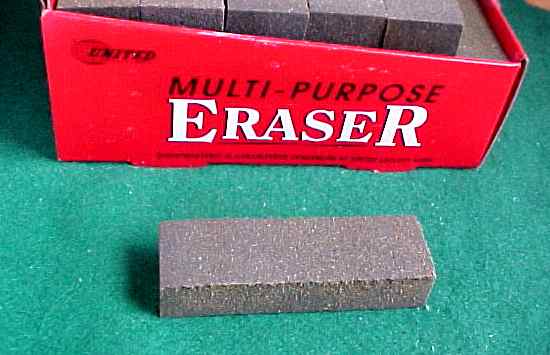
The "rust eraser" isn't a sharpener, but it's useful in restoring your knife in the event of tarnish or rust. It's somewhat abrasive, and will leave a satin finish. It's quite effective in removing light rust and tarnish, but not deep pitting. They are about 3 1/8" long, 1" wide, and 5/8" thick. Current stock is from Lansky.

This has to be the original snake oil. At the turn of the last century the Kaiser's Wehrmacht put out bids for a military multi-purpose oil. It was to clean and lubricate firearms and other machinery, prevent rust, dissolve residue from corrosive primers, nitro powder and black powder, remove copper, zinc and lead fouling from rifle bores, preserve both wood and leather, prevent mold and mildew, and be suitable for treating minor wounds and abrasions on the soldiers themselves. By all accounts Ballistol met the requirements, and then some. It was adopted by the German military in 1905 and served until 1945. It’s still in use by the German Special Forces, as well as the US Coast Guard and some of the Navy Seal teams. Of course a multitude of European hunters and other sportsmen have used it for generations..
Ballistol is slightly alkaline, so it neutralizes the amino acids in human sweat. It emulsifies with water, so it will protect wet surfaces as well as dry surfaces. The mixture prevents rust, and when it dries it leaves a protective film. As a lubricant it never thickens or gums up. Mixed half and half with water it makes a black powder cleaner. Mixed 1:20 with water it’s a cutting fluid. On unfinished wood surfaces it helps seal and protect the wood, as well as bringing out the beauty of the grain. It restores old oil finished surfaces. It softens old dried leather and protects from mold and mildew. (Warning; it darkens light leather, and is not for use on suede.)
Ballistol is approved for use on equipment used in food preparation. However it hasn’t been submitted to the US Food and Drug Administration, so labeling in the US indicates it’s not for use on animals or humans. In Germany it's often included in first aid kits, and even used internally in some folk medicines.
Balistol is environmentally friendly. It’s non-toxic and biodegradable. There are no carcinogens. It comes packed in either a pump spray can, or aerosol cans which contains no CFCs. The aerosol propellent is flamable, so you shouldn’t use it around a flame. Shelf life is unlimited in the original can.
The downside; (you knew there had to be one). The stuff stinks, literally, at least on first application. The initial smell is between old sweat socks, and something much more vulgar. After a bit however, it just leaves a faint odor resembling black licorice. I’m told that the smell is common to most German gun shops and hunting lodges. I suppose, like the smell of Hoppe’s No. 9, it’s an acquired taste. I’ve gotten quite accustomed to it, although I found it offensive initially.
Note: it's not recommended for long term storage of nickel or chrome plated firearms. These metals are plated over a base of copper. If there is a break in the plating the Ballistol can attack the under-plating.
In four sizes:
1 1/2 ounce aerosol,
4 ounce non-aerosol can. (no pump, but the can will take the standard pump from shower sprays, Windex etc).
6 ounce aerosol,
16 ounce non-aerosol can.(no pump, but the can will take the standard pump from shower sprays, Windex etc).
Note: Aerosol cans cannot be sent Priority Mail, which goes by air. They will go by ground parcel post. Please allow extra time for delivery.
Please Click on the Credit Card Symbol Below for the order form